Questions to Ask Before Hiring an Epoxy Floor Contractor | Queen Creek AZ
What Questions Should I Ask Before Hiring an Epoxy Floor Contractor?
Hiring an epoxy floor contractor without asking the right questions is one of the most common ways Queen Creek homeowners end up with a floor that's peeling in 18 months.
The problem is that epoxy flooring looks the same on day one whether it was installed correctly or not. The difference shows up 6, 12, or 24 months later — when the cheap installation starts peeling, yellowing, or bubbling under Arizona's heat and UV.
The questions below are designed to reveal that difference before you sign anything. Ask every contractor you're considering these questions. The answers — and how confidently they give them — will tell you everything you need to know.
1. Do You Use Diamond Grinding or Acid Etching?
This is the most important question on the list. Ask it first.
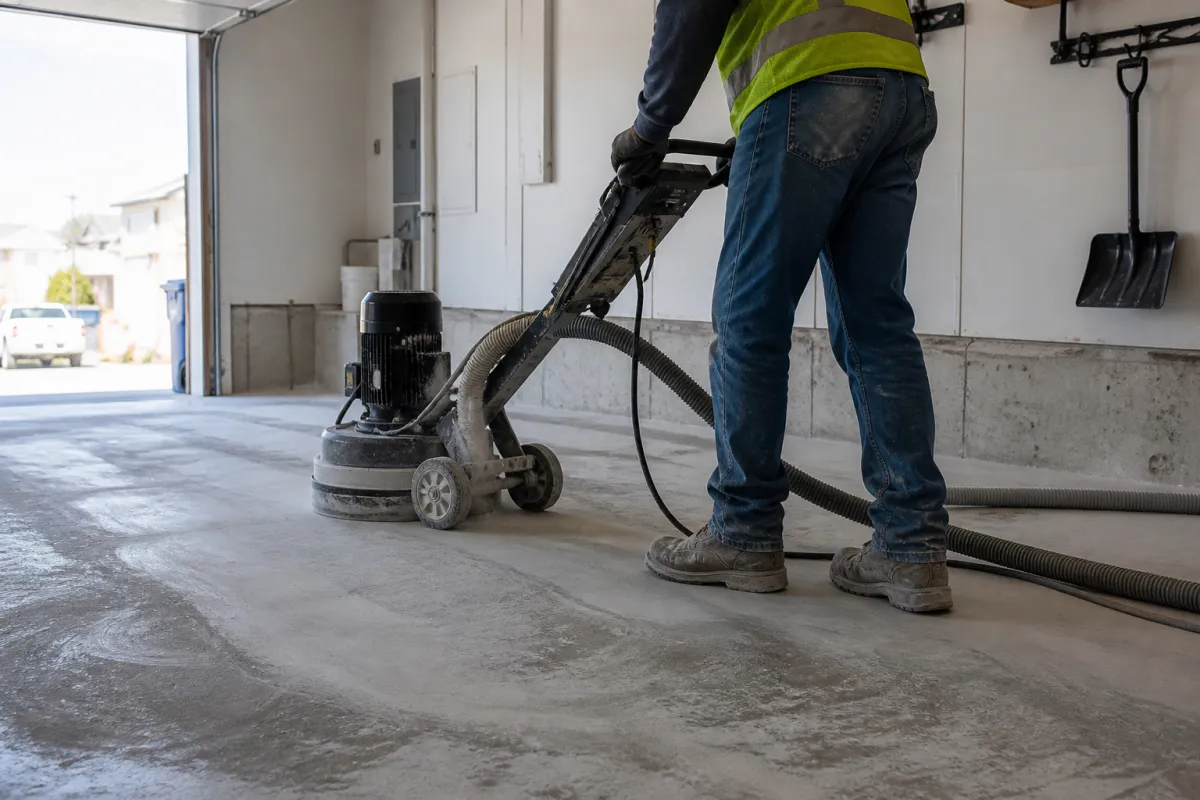
Diamond grinding is a mechanical surface preparation process that uses industrial diamond-tipped grinding wheels to open the concrete's pores and create a rough surface profile — similar to 80-grit sandpaper — that the epoxy bonds into mechanically. It creates a strong, lasting adhesion.
Acid etching is a chemical process that slightly roughens the surface but produces a far weaker bond. It's faster, cheaper, and used by budget contractors and DIY kits.
The correct answer is diamond grinding. Only diamond grinding. If a contractor tells you acid etching is fine or that "they use their own method," that's a red flag. Surface preparation is the single biggest predictor of how long your floor will last — and no amount of quality product can compensate for inadequate prep.
2. What Is the Solids Content of Your Epoxy?
Professional-grade epoxy is rated by solids content — the percentage of the wet product that remains on your floor after application. The rest evaporates.
The correct answer is 100% solids. This means every drop you apply becomes part of your finished floor — a thick, dense film with real mechanical strength and chemical resistance.
Budget products and DIY kits use 30–50% solids. Up to 70% of the product evaporates, leaving a thin, weak film that scratches, chips, and fails under Arizona's thermal cycling and UV exposure.
If a contractor doesn't know what solids content means, or can't tell you the solids content of the product they plan to use on your floor, move on.
3. Is Your Topcoat Aliphatic or Aromatic?
This question separates contractors who understand Arizona's climate from those who don't.
Aliphatic polyaspartic topcoats are UV stable — they maintain their color and clarity indefinitely, even in Queen Creek's intense direct sun.
Aromatic epoxy topcoats are not UV stable. They yellow, chalk, and degrade under UV exposure. In Arizona, this process can begin within 6–12 months. If you've ever seen a garage floor that was installed clean gray and turned patchy yellow — that's aromatic epoxy under Arizona sun.
The correct answer is aliphatic. Any professional contractor working in Arizona's climate should be using aliphatic polyaspartic topcoats on every job. If they don't know the difference between aliphatic and aromatic, that's a serious problem.
4. Can You Provide the Product Data Sheet?
Every legitimate professional epoxy product comes with a Technical Data Sheet (TDS) that lists the solids content, chemical type, application temperature range, cure time, and performance specifications.
Asking for a TDS does two things: it confirms the contractor is using a professional product, and it lets you verify their claims about solids content and aliphatic vs. aromatic chemistry.
A contractor using quality materials will hand you a TDS without hesitation. A contractor using budget or unknown products won't have one to provide.
5. What Is Your Warranty and What Does It Cover?
A contractor confident in their materials and workmanship backs it up with a written warranty. For a professionally installed residential epoxy floor, a minimum 10-year adhesion warranty is standard.
Dig into the details:
Does the warranty cover peeling and delamination?
Does it cover chipping at edges and joints?
What voids the warranty — and is that list reasonable?
Is the warranty from the contractor or just from the product manufacturer?
Get the warranty in writing before any work begins. A verbal warranty is worth nothing if the contractor is unresponsive when you call with a problem two years later.
Watch out for vague language like "satisfaction guarantee" or "we stand behind our work" without specific terms. That's not a warranty — it's a marketing phrase.
6. Are You Licensed and Insured in Arizona?
This is non-negotiable before anyone works on your property.
In Arizona, contractors performing flooring work are required to be licensed through the Arizona Registrar of Contractors. You can verify any contractor's license at roc.az.gov — enter their name or ROC license number and confirm it's current and in good standing.
Ask for proof of:
Arizona ROC contractor's license
General liability insurance (protects you if your property is damaged during installation)
Workers' compensation insurance (protects you if a worker is injured on your property)
An unlicensed contractor has no accountability. If something goes wrong — a damaged vehicle, a slip and fall, a floor that fails — you have no recourse. Always verify before signing.
7. How Long Have You Been Installing Epoxy Floors in Queen Creek?
Experience in Arizona specifically matters. Epoxy installation in a 70°F climate is different from installation in Queen Creek where summer concrete surface temperatures can exceed 150°F.
An experienced Arizona contractor knows:
Which products perform in extreme heat and UV
How to manage cure times in high temperatures
How to schedule work to avoid the hottest part of the day in summer
How to handle the moisture changes that come with monsoon season
Ask how many floors they've installed locally, and ask specifically about their experience in Queen Creek and the East Valley. A contractor who's been working in this market for years will be able to speak to the specific challenges — and a contractor who can't is likely newer to the area or the trade.
8. Can You Show Me Photos of Completed Projects?
Any experienced epoxy floor contractor should have a portfolio of completed projects. Ask to see:
Photos of finished floors in styles similar to what you want
Before and after photos showing the concrete condition going in
Projects in Queen Creek or nearby East Valley cities specifically
Local photos matter because they show work done in the same climate and conditions your floor will live in. A contractor who can only show you photos from out-of-state jobs hasn't proven they understand Arizona's specific demands.
If they don't have photos — or only have stock images that look too perfect to be real job photos — be cautious.
9. How Do You Handle Existing Cracks and Surface Defects?
Every concrete floor has some cracks, divots, or surface imperfections. What a contractor does about those before coating is a direct indicator of their quality standards.
The correct answer: they fill all cracks with a semi-rigid polyurea crack filler before any coating is applied. Hairline cracks that open up during diamond grinding get filled. Larger structural cracks get evaluated and addressed appropriately.
A contractor who plans to coat over cracks without filling them is either cutting corners or doesn't know what they're doing. Unfilled cracks telegraph through the coating over time, cracking the epoxy above them and creating entry points for moisture.
10. What Is Your Process If Something Goes Wrong?
This question reveals a contractor's character more than any other.
Ask them directly: if my floor starts peeling six months from now, what happens?
A contractor who stands behind their work will walk you through their process — they'll come out, assess the problem, determine whether it's a material failure or a preparation issue, and make it right under their warranty.
A contractor who gives a vague answer, changes the subject, or suggests you'd be responsible for any future issues is telling you something important about what happens after they cash your check.
The Red Flags to Watch For
Beyond the specific questions above, here are behaviors that should make you pause regardless of price:
They can't explain their process in plain language. A good contractor should be able to walk you through every step of what they'll do to your floor in plain terms. If they're vague, it's usually because the process is vague.
They push for a deposit before seeing your floor. Any reputable contractor gives you a free on-site quote before asking for money. Quotes done over the phone or via text message without seeing the concrete aren't accurate.
They pressure you to decide immediately. High-pressure tactics — "this price is only good today" or "I have another customer interested in this slot" — are sales manipulation, not legitimate business practice.
Their price is dramatically lower than everyone else. Price shopping is smart. But if one quote is 50% lower than the others, ask what's different about what they're installing. The answer is almost always lower-quality materials, a faster preparation process, or both.
They have no reviews or reviews that all look the same. Check Google, Yelp, and the BBB. Look for specific, detailed reviews that mention the process, the crew, and how the floor is holding up over time — not just "great service, 5 stars."
What Good Answers Sound Like
The right contractor for your Queen Creek garage floor will answer every question on this list without hesitation. They'll tell you they diamond grind every floor, use 100% solids epoxy, and apply an aliphatic polyaspartic topcoat because they know what Arizona's UV does to aromatic products. They'll hand you a product data sheet if you ask. They'll have a written warranty they're confident in and a portfolio of local work they're proud of.
That clarity and confidence is what you're looking for. Vague answers, subject changes, and irritation at your questions are what you're avoiding.
Get a Free Quote From a Queen Creek Epoxy Specialist
Ready to move forward with your garage floor? We connect Queen Creek homeowners with licensed, insured epoxy flooring professionals who use professional-grade materials and stand behind their work with a 10-year warranty.
We serve Queen Creek, San Tan Valley, Gilbert, Chandler, Mesa, Gold Canyon, Maricopa, and Apache Junction. Call (480) 573-8085 or visit epoxyflooringqueencreek.com for a free on-site quote.
Epoxy Flooring Queen Creek connects East Valley homeowners with licensed, insured epoxy flooring professionals using professional-grade materials built for Arizona's climate.
