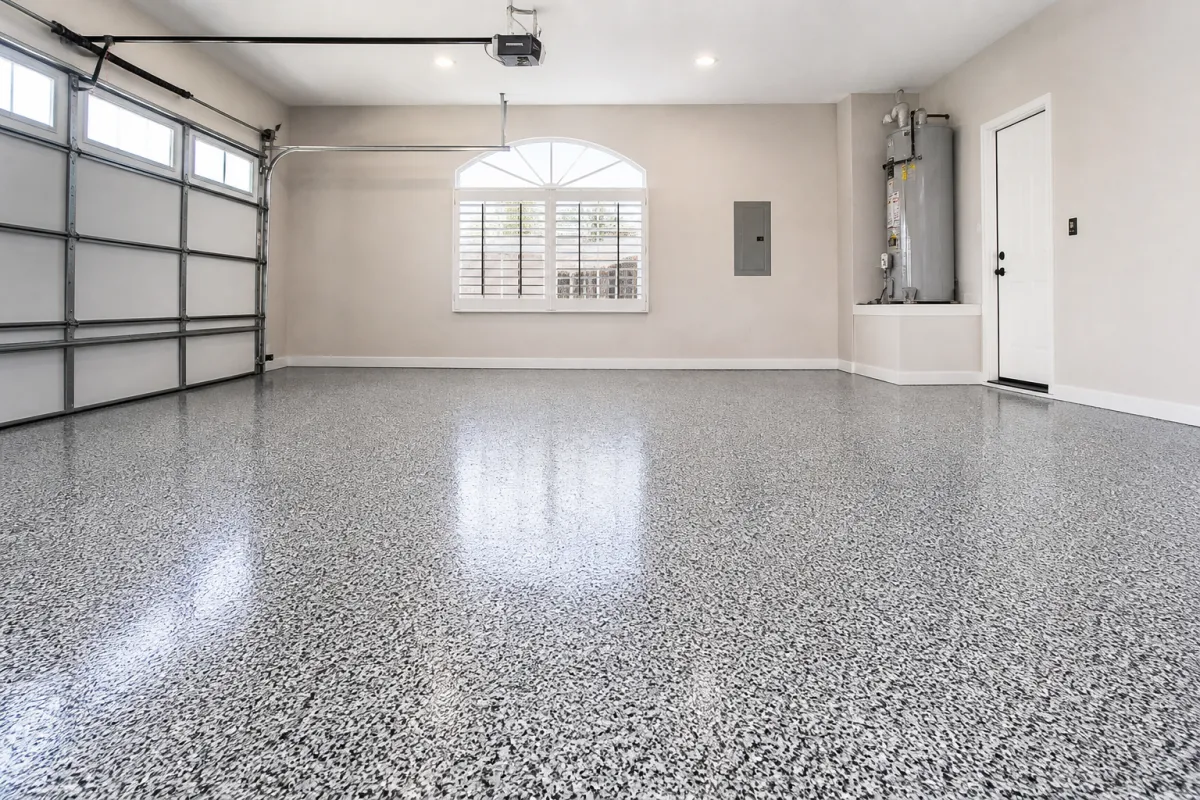
Why DIY Epoxy Floors Fail in Arizona (And What to Do Instead)
If you've ever bought an epoxy floor kit from Home Depot or Lowe's, applied it on a Saturday, and watched it start peeling six months later — you're not alone. It's one of the most common calls we get from Queen Creek homeowners.
The frustrating part is that it's not your fault. DIY epoxy kits are simply not designed for Arizona's climate. Here's exactly why they fail — and what actually works.
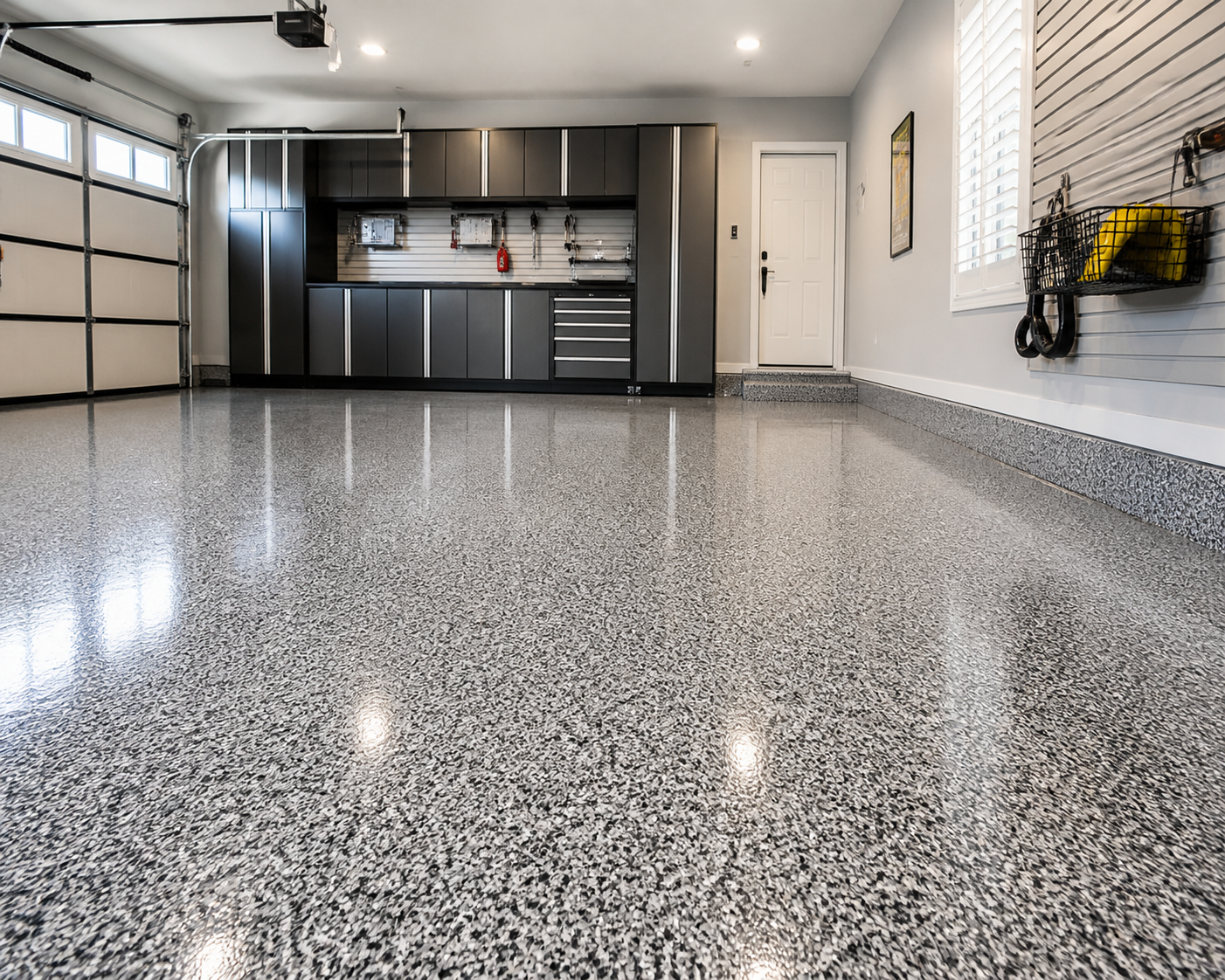
The 3 Reasons DIY Epoxy Fails in Queen Creek
1. The Products Aren't UV Stable
This is the biggest one. Standard epoxy is an aromatic compound — meaning it contains aromatic ring structures in its polymer chain that react with UV radiation. In most climates, this is a slow process. In Queen Creek, where the UV index is among the highest in the continental United States and garages bake in direct sun for 8+ hours a day, yellowing can begin within 3–6 months.
You've seen it — a garage floor that was a clean gray when it was installed and is now a patchy yellow-brown. That's UV degradation. Once it starts, there's no reversing it.
Professional installers use aliphatic polyaspartic topcoats — chemically different from standard epoxy — that are 100% UV stable. They don't yellow. They don't chalk. They look the same in year 10 as they did on day one.
2. Low Solids Content = A Thin, Weak Film
Epoxy coatings are rated by their "solids content" — the percentage of the wet product that actually stays on your floor after the solvents evaporate. The rest goes into the air.
DIY kits sold at hardware stores typically have 30–50% solids content. That means up to 70% of what you brush on disappears. What's left is a paper-thin film that scratches easily, chips at the edges, and can't withstand the thermal stress of Arizona's temperature swings.
Professional systems use 100% solids epoxy — every drop you apply stays on the floor. The result is a film that's 3–4 times thicker than a DIY application, with dramatically better abrasion resistance, chemical resistance, and durability.
3. Inadequate Surface Preparation
This is the one most people don't know about — and it's arguably the most important factor of all.
DIY kits come with an acid etching solution to prepare the concrete before coating. Acid etching does open the concrete surface slightly, but it doesn't create the surface profile needed for a strong mechanical bond between the coating and the concrete.
Professional installers use diamond grinding — a mechanical process that uses industrial diamond-tipped grinding wheels to open the concrete's pores and create a surface profile roughly equivalent to 80-grit sandpaper. The epoxy fills into these microscopic valleys and locks in mechanically, creating a bond that's dramatically stronger than anything acid etching can achieve.
When a floor delaminates and peels up in sheets — which you've probably seen photos of online — inadequate surface prep is almost always the cause.
What Happens When You Add Arizona Heat
Arizona's climate adds another layer of difficulty that most product manufacturers don't account for:
Hot tire pickup. When you park your car in the garage after driving in summer, your tires can be 150–180°F. Standard epoxy softens at these temperatures and literally sticks to the tire, pulling the coating off the floor when you back out. Professional polyaspartic topcoats are rated for 200°F+ and don't soften.
Thermal cycling. Queen Creek concrete can swing 80°F+ between a summer afternoon and a winter night. This constant expansion and contraction puts massive stress on any coating that isn't properly bonded to the concrete or flexible enough to move with it. A thin, poorly bonded DIY coating cracks and delamdinates under this stress within 1–2 seasons.
Application temperature. Most DIY epoxy products have an optimal application temperature range of 50–85°F. In Queen Creek, there are maybe 4 months of the year where you can reliably apply a coating in that range. Apply outside that range and the epoxy cures too fast or too slow — resulting in fisheyes, bubbles, or poor adhesion.
How Long Does a Professional Epoxy Floor Last in Queen Creek?
A professionally installed epoxy floor in Queen Creek — using diamond grinding prep, 100% solids epoxy base coat, and a UV-stable aliphatic polyaspartic topcoat — should last 15–20 years with basic maintenance.
We back every installation with a 10-year adhesion warranty. If the floor peels or chips under normal residential use within 10 years, we fix it at no charge. That's how confident we are in the system.
By contrast, most DIY floors in Arizona last 1–3 years before peeling, yellowing, or chipping to the point of needing replacement.
The Real Cost Comparison
It's easy to look at a $150 DIY kit and think you're saving money compared to a $1,800 professional installation. But here's the math over 20 years.
A DIY epoxy kit in Arizona lasts roughly 2 years before it needs replacing. Over 20 years that's approximately 10 replacements at $150 each — $1,500 in materials alone, not counting the labor of sanding off the failed coating each time or the disruption of having your garage out of commission every couple of years.
A professional installation costs $1,800 upfront and lasts 20 years. One disruption. One payment. Done.
And that doesn't account for the cumulative damage to your concrete from repeated acid etching, or the fact that a peeling, yellowed garage floor actively hurts your home's value every time a potential buyer sees it.
The professional installation isn't just the better floor — over time it's the cheaper option.
What to Look for in a Professional Installer
If you're ready to do this right, here's what to ask any contractor before hiring them:
"Do you use diamond grinding or acid etching?" Diamond grinding only. If they say acid etching, move on.
"Is your topcoat aliphatic or aromatic?" Aliphatic only. If they can't answer this question, that's a red flag.
"What is the solids content of your epoxy?" 100% solids. Anything less is a compromise.
"Do you offer a warranty?" A minimum 10-year adhesion warranty is standard for professional installations.
Get a Free Quote for Your Queen Creek Garage
If your garage floor is bare concrete, a failed DIY job, or a floor that's starting to peel — we can help. We offer free on-site quotes throughout Queen Creek, San Tan Valley, Gilbert, Chandler, Mesa, Gold Canyon, Maricopa, and Apache Junction.
Call us at (480) 573-8085 or visit epoxyflooringqueencreek.com to request your free quote.
Epoxy Flooring Queen Creek serves the entire East Valley with professional garage floor coatings, metallic epoxy systems, polyaspartic concrete coatings, and commercial floor installations. All work is performed by licensed and insured contractors and backed by a 10-year adhesion warranty.
